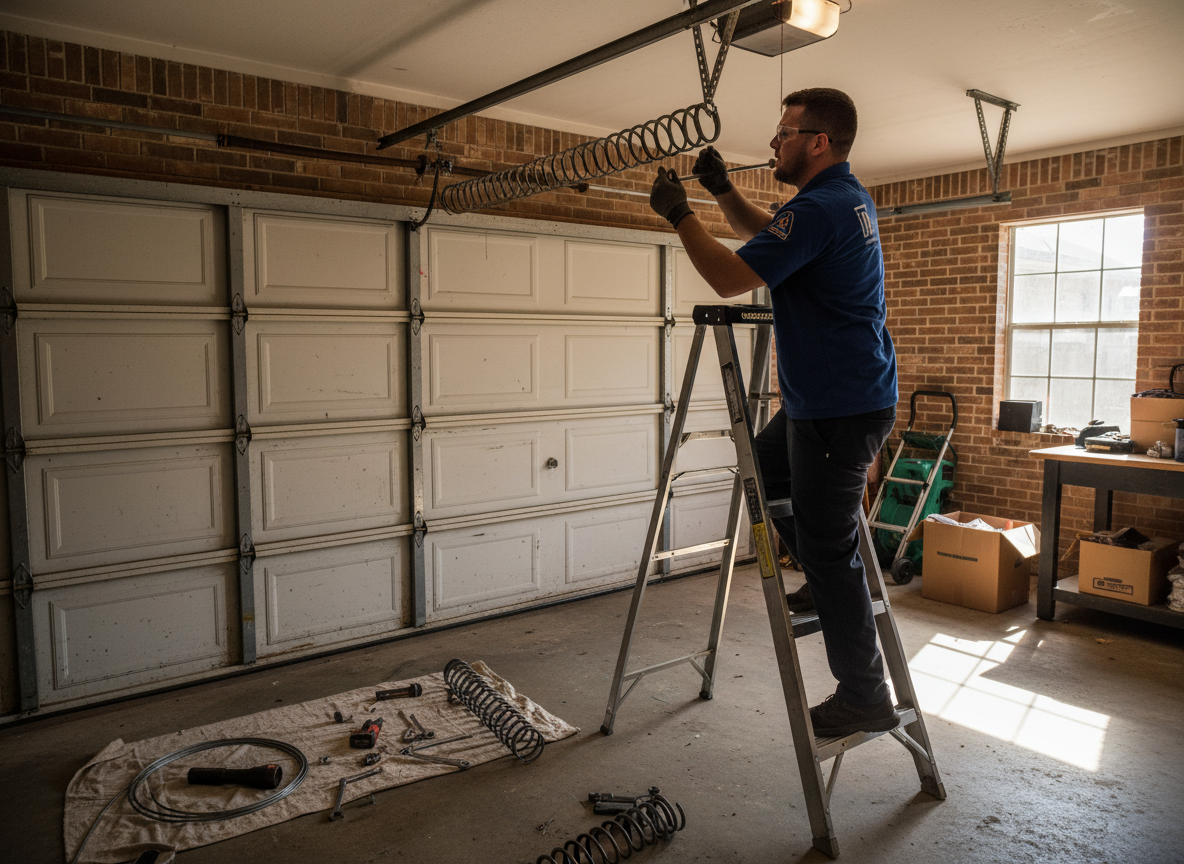
Garage Door Repair Plano is based at 3405 Custer Rd #149, and we work on residential doors across Plano, from older ranch-style homes near Haggard Park to newer builds around Legacy West and the Preston Road corridor. A garage door looks simple until it stops, and it usually stops at the worst moment, like a weekday morning with a car already late. Our approach is to find out exactly what failed, show you the worn part beside its replacement, and explain every finding in writing before we touch a single bolt. Spring work, cable and roller replacement, opener repair and routine maintenance are all covered on this page.
Why Plano Homeowners Call Us
Trust in this trade comes down to things you can check for yourself, so we build every visit around evidence rather than assurances. Each job begins with a documented inspection of the door panels, tracks, springs, cables, hardware and opener, and you receive those findings in writing before any work begins. When a component needs replacing, we lay the old part next to the new one so you can compare wear, length, wire gauge and finish in person. Our office on Custer Road is where scheduling, parts ordering and follow-up all happen, so the people who booked your visit are the same operation that answers for the work afterward. We keep the written record of what was inspected, what was replaced and what was left alone, which means you always know why the door is safe to run. If a repair is not needed yet, we tell you that plainly and note what to watch over the next few months. Many customers come back for this kind of straight talk more than for any single repair. It is the reason we explain every step and leave the decision with you, which is how a one-time visit becomes a long-term relationship with a door that behaves.
Why Now Is the Right Time to Look at Your Door
Plano garage doors work hard in a climate that is unkind to moving metal. Summer afternoons push garage temperatures well past what the average homeowner would tolerate, and that heat thins the lubricant on rollers, hinges and spring coils. Once the lubricant dries out, friction moves into parts that were not designed to carry it, and you hear the grinding, popping or slow lift that tends to show up before a failure. Winter is not kind either. Cold snaps stiffen weatherstripping and make old cables less forgiving, so a door that opened easily in October can stick in January. Spring brings its own problems, including hail season, when dings in steel panels can bend tracks or pull a section out of alignment. Clay soil under many Plano slabs also shifts over time, which can change how the door sits in its opening and throw the tracks out of plumb. None of these issues feels urgent on the day it starts, but each one adds stress to the springs that lift your door. A torsion spring that is already near the end of its cycle will fail under the first hot afternoon that asks a little more from it. Looking at the door now, while the failure is still a worn part rather than a broken one, is the most reliable way to keep a bad morning from becoming an emergency. A short inspection in the cooler months gives you time to plan, compare options in writing and schedule work on your terms.
How the Work Is Done Properly
Good repair work is mostly disciplined sequencing, and that discipline is what separates a fix that lasts from one that returns in a few weeks. We start by confirming the door is in a safe state before anyone steps near the springs, then check the drum, cable, shaft, bracket and track geometry while the door is still in its original position. Each finding is recorded in plain language, including the parts we recommend, the parts we would leave alone and the reason for each decision. Before any work begins, we walk you through the old and new components so the reasoning is visible rather than hidden behind a service ticket. During the work, we replace components in a set order, check tension and balance at each stage, and test the door through several full cycles. Once the repair is complete, we run the opener and safety reversal tests, confirm the door stops and reverses as designed, and leave you with a written summary of what changed. We clean up the work area and remove the old parts with you present. This step-by-step method takes more time than a quick swap, but it means the door you walk into your garage tomorrow is the one we actually inspected today.
A Plano Scenario: The Hot August Morning
Picture a two-car garage in a Plano subdivision built in the late 1990s, with a door that has worked fine for years. In August, the homeowner pulls out for an early commute along the Dallas North Tollway, and the door stops halfway up with a loud bang that rattles the house. Inside the garage, the room is already warm, the light is dim, and a single torsion spring has snapped, leaving the door heavy and unbalanced. The first instinct is to force the door up by hand or to run the opener repeatedly, and both of those choices can damage the opener and the remaining hardware. In a situation like this, the right first step is to keep everyone clear of the door and avoid tensioning anything. Our visit would begin with a careful look at the broken spring, the winding cones, the cable drums and the lift tracks, because a single failure often points to fatigue that has been building for some time. We would photograph the broken spring, measure the remaining spring and explain in writing whether the second spring should be replaced at the same time. The new spring is installed with the correct winding and tension, and we show the homeowner the old spring beside the new one so the difference in wire size and coil condition is obvious. The door is then tested through several full open and close cycles, and the safety reversal is verified before we leave. The outcome is a door that lifts smoothly again, a clear record of what was replaced and why, and a homeowner who understands the work well enough to plan the next maintenance visit without guessing.
Torsion Springs in Plano Garages
Torsion springs carry most of the weight of a residential door, and they are the part most likely to fail without warning. Each spring is rated for a set number of cycles, and in a Plano garage with heavy summer heat and daily use, that rating can be reached sooner than many owners expect. Here is what matters when a spring is evaluated:
- Cycle wear shows up as gaps between coils, rust at the winding cone, or a spring that looks uneven when the door is closed.
Technician insight
In Plano, the thing that catches most people out with Garage Door Spring Repair and Replacement is waiting for a spring to snap before looking at it, when the wear was visible months earlier as gaps between coils or rust at the winding cone. Our long Texas summers dry out lubrication and push springs harder on the hottest afternoons, so a door that felt fine in May can fail in August. We always replace springs in pairs when one has failed, because the surviving spring has been carrying the same load for just as long.
Torsion Spring Failure During a Hot August Commute
A Plano homeowner in a late-1990s subdivision found the garage door stopped halfway up with a loud bang and a visibly broken torsion spring. The inspection showed the partner spring was also worn, with coil gaps and surface rust, which explained why the failure had happened under heat. We documented both springs in writing, showed the old and new parts side by side, and replaced them as a matched pair with correct winding and tension. The door was tested through several full cycles, and the homeowner left with a clear record of the work and a schedule for the next check.
Garage Door Spring Repair and Replacement Services We Offer
✓Garage Door Spring Repair and Replacement
Torsion and extension spring work that restores balance and lift. We inspect both springs, explain wear in writing, and show the old and new springs side by side before installation.
✓Garage Door Opener Repair
Diagnosis and repair of openers, safety sensors, remotes and limit settings. Each safety reversal function is tested under load before we consider the job complete.
✓Garage Door Cable and Roller Replacement
Worn cables, cracked rollers and loose drums replaced in balanced sets. We check track alignment at the same time so the new parts run true.
✓Garage Door Maintenance Visits
A scheduled inspection covering lubrication, hardware tightness, sensor alignment and weatherstripping. You receive a written summary of conditions and what to watch next.
✓Garage Door Panel and Track Repair
Dented panels, bent track sections and out-of-plumb runs repaired or replaced after impact or slab movement. Each finding is documented before the work starts.
How it works
- 1
Inspection and Safety Check
We confirm the door is in a safe state, then inspect springs, cables, drums, tracks, rollers, hardware and the opener while the door is still in its original position.
- 2
Written Findings
Every finding is recorded in plain language, including what we recommend, what can wait and the reason for each decision. You receive this before any work begins.
- 3
Old and New Parts Walk-Through
We lay the worn components beside their replacements so you can compare wear, size, finish and condition in person before anything is installed.
- 4
Careful Repair Sequence
Parts are replaced in a set order, with tension, balance and alignment checked at each stage rather than only at the end of the job.
- 5
Testing and Written Summary
The door is run through several full cycles, safety reversal is verified, the work area is cleaned, and you receive a written summary of what changed and why.
Pricing
Every recommendation is explained in writing before work begins, so you can review the findings and decide how to proceed with full information.